Winter Salad: A Wayfarer's Discovery in Darkness
In the frozen depths of a Siberian winter, Jonathan discovers that God's most sustaining provisions often come from the darkest, coldest seasons of life.
RECIPIES OF RESILIENCE
Wandering Armenian
1/26/20263 min read
Winter Salad: A Wayfarer's Discovery in Darkness
February 2019. Eastern Europe. The kind of cold that makes your breath freeze mid-air and your hope feel equally crystallized. I'd been deployed to a remote village where temperatures plunged to minus forty, and our family had accompanied me for what would become the longest winter of our lives.
The assignment was meant to be six weeks. It stretched to four months when border closures trapped us. Our supplies dwindled. Sarah grew dejected. Caleb, now thirteen, stopped speaking for days at a time. Ethan, eleven, cried himself to sleep. And I, I questioned everything. My calling. My faith. My decision to drag my family into this frozen wasteland.
"There's nothing green here, Papa," Ethan whispered one night. "Everything's dead."
He was right. Snow buried everything. Darkness dominated, the sun barely clearing the horizon for three hours daily. The village of Ovidiu, itself seemed lifeless, its people moving like shadows through the perpetual twilight.
Then I met Nikolai, a weathered farmer who'd survived seventy such winters. He invited us to his home, a small, warm cottage that smelled of earth and bread. What he served changed everything.
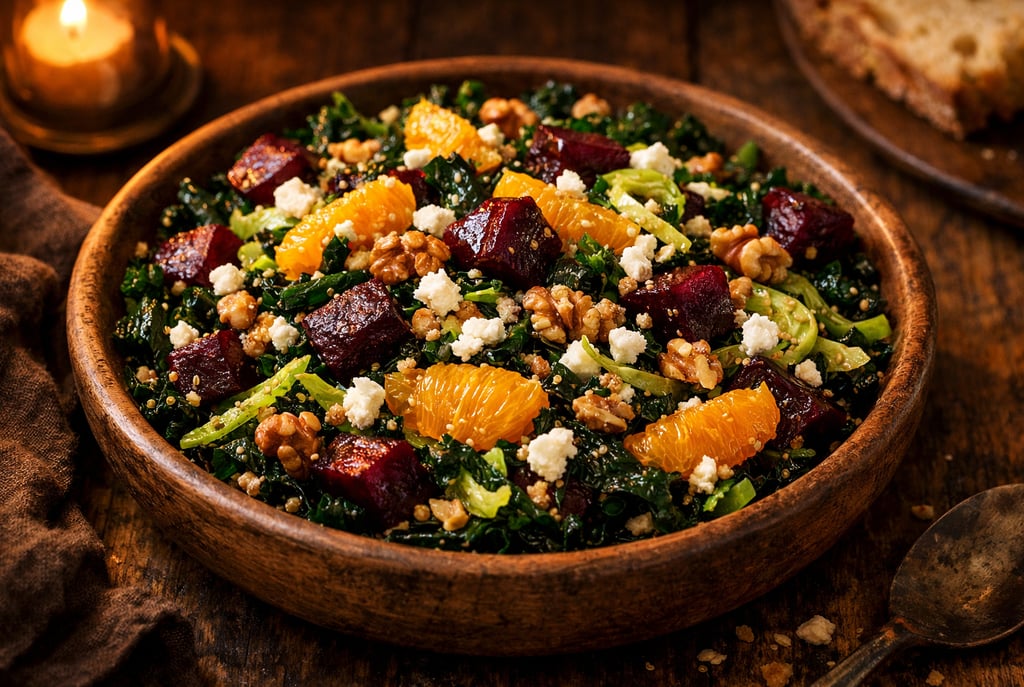
A winter salad. But not delicate spring greens or colorful summer vegetables. This was substantial, almost defiant-Massaged kale (dark, hardy, grown in his greenhouse), roasted beets (deep purple, stored in his root cellar since autumn), orange segments (brought by traders), walnuts (gathered months ago), shaved Brussels sprouts (still clinging to frozen stalks in his garden), crumbled cheese, and quinoa.
"This," Nikolai said in halting English, "is winter's truth. The deepest provision comes from the darkest season."
He held up the kale. "This grows in snow. Becomes sweeter after frost. Winter doesn't kill it but winter perfects it."
Then the beets. "These lived underground all autumn, storing sunlight in their flesh. In deepest winter, they give back the sun they absorbed in warmth. They remembered summer for us."
The orange. "Someone carried this across frozen roads to reach us. In our darkest season, connection sustained us."
He pointed to the walnuts. "We gathered these before winter came. Provision made in light sustains us through darkness. What we stored in faith, we eat in trial."
Sarah was crying. Not from sadness anymore, but recognition.
Nikolai continued, "Winter salad teaches what summer salad cannot. Summer says, 'See how easy abundance is!' But winter says, 'See how deep My faithfulness goes. Even here. Even now. Especially now.'"
He opened his worn Russian Bible to Psalm 23:5 "You prepare a table before me in the presence of my enemies."
"Winter is the enemy," he said quietly. "Darkness. Cold. Death. And yet, look at this table. God prepares feast in the presence of our deepest winter. Not after winter ends, but During it."
That night, our family sat in Nikolai's cottage, eating winter salad by candlelight. And I understood something profound: winter foods are not lesser provisions; they're specialized nourishment designed for the soul's harshest seasons.
The hearty kale that withstands frost. The stored beets that remember sunshine. The quinoa that provides complete protein when strength fails. The citrus that prevents scurvy in darkness. Every ingredient was purposeful, designed for survival and sustenance when everything else fails.
"Papa," Caleb said, it was his first words in a week-"God knew we'd need this kind of food. Not just for winter, but for winters in our hearts."
Yes. Exactly.
Winter salads teach us that God's provision in our darkest seasons isn't accidental or inferior, it's precisely calibrated for survival. When life feels frozen, when hope seems buried under snow, when darkness dominates, that’s when we need to understand that God hasn't abandoned the table. He's prepared a different feast, one designed specifically for endurance.
The Kale of His Word, sweetened by trials. The stored sunshine of past faithfulness, sustaining us when we can't feel His warmth. The connections of community, carried across frozen distances. The provisions gathered in faith during better seasons.
We returned home in late March. Now, every winter, Sarah makes what we call "Nikolai's Winter Salad”, -massaged kale, roasted beets, oranges, and quinoa. We serve it during our family's hardest moments, not just in seasonal winter, but in life's winters too.
Because winter salad whispers the gospel's deepest truth: "The Lord is close to the broken-hearted and saves those who are crushed in spirit" (Psalm 34:18).
In our coldest, darkest seasons, when nothing seems to grow and death appears to reign, there, especially there, God prepares a table. Hearty. Nourishing. Exactly what we need to survive until spring.