Where the Ashes Meet the Crescent
A Devotional Story of Dust, Devotion, and the Divine Thread That Binds Us All Two ancient faiths. One sacred season. A wayfarer's lifetime of watching humanity bow before something greater than itself.
TALES AND TRAVEL
Wandering Armenian
2/26/202611 min read
Where the Ashes Meet the Crescent
The Dust on His Forehead and the Moon in Their Eyes
Jonathan had always been a man who noticed things others walked past.
He noticed the way morning light hit a tin roof in a Sudanese camp differently than it hit the stained glass of his childhood church back home. He noticed how hunger looked the same on every face, regardless of the language the lips around it spoke. And he noticed with a quiet wonder that had been growing in him since boyhood - how, in the great turning wheel of the calendar, two of humanity's most ancient seasons of the soul so often arrived together, like old friends who had never been formally introduced but somehow always found themselves at the same crossroads.
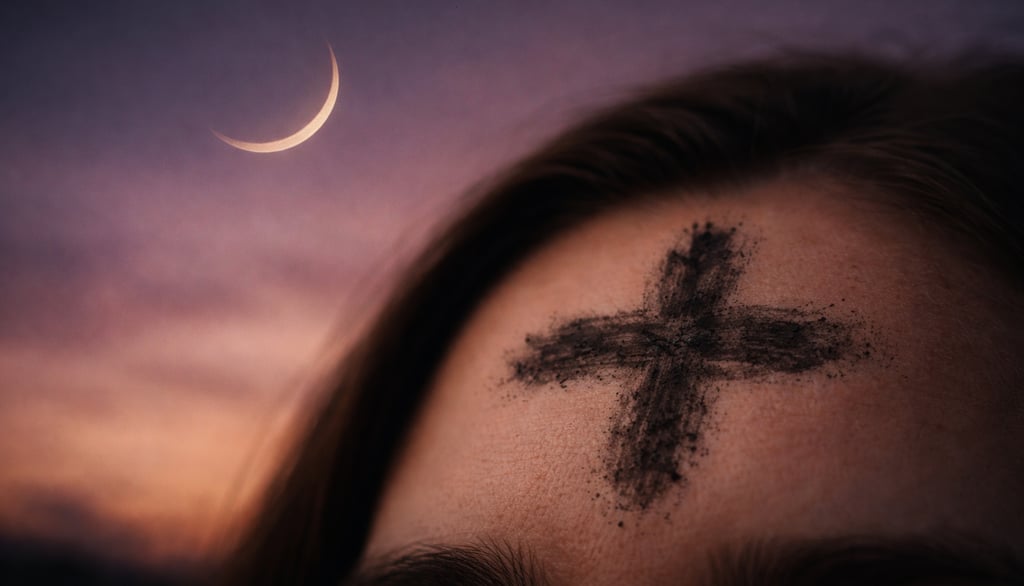
Ash Wednesday and Ramadan.
He had seen it first as a small boy, perhaps seven or eight years old, kneeling beside his grandfather in an old Portuguese stone church somewhere along Konkan costal countryside where the salt wind off the Arabian Sea crept through the cracks in the walls and the smell of incense had soaked so deep into the old Portuguese stonework that it seemed to bleed out of the very rock itself. The priest's thumb pressed cold ash against his smooth forehead, and the words fell like stones into still waters: "Remember that you are dust, and to dust you shall return." He did not fully understand then. But the feeling of it, the weight, the solemnity, the strange tenderness of being told he was fragile that he never forgot. It planted something in him. A seed that would not bloom until he had walked very long and very dusty roads.
Jonathan became an aid worker in his early thirties, almost by accident or perhaps by appointment, as he would come to believe. He ran into his first refugee camp in Central Aisa with a clipboard and clean boots, and he ran out of his hundredth with cracked hands and a heart broken open in precisely the right places.
The Road That Taught Him to Read the Ashes
It was in a camp somewhere on Sudanese border, during what must have been his fifteenth or sixteenth year in the field, that Ash Wednesday and Ramadan arrived together in a way Jonathan could not simply file away as coincidence.
The camp was vast and exhausted. Tens of thousands of people lived there in a city of plastic sheeting and borrowed time. The population was extraordinarily mixed-Christian families from the south, Muslim families from the east, and every shade of human story in between. The morning Jonathan arrived, a Wednesday in late February, he had ash on his forehead. He had attended a small, makeshift Ash Wednesday service held by a Jesuit priest Monsignor Greg, who travelled these camps like a pilgrim, carrying a small pot of palm ash and an enormous gentleness. Well, if I could picture him for you here, I would have says Jonathan with a faint smile.
The ash was still visible on Jonathan's brow when he sat down with a group of Muslim community leaders to discuss the water distribution schedule for the coming month. One of them, an elder named Ibrahim, a man with eyes the colour of deep river water and a beard touched by silver looked at Jonathan's forehead for a long moment.
"Today is your beginning?" Ibrahim asked softly in French.
"Lent," Jonathan said, nodding. "Forty days."
Ibrahim smiled slowly. "Tonight," he said, "we watch for the moon."
They looked at each other across a folding table covered in logistics papers, two men from two worlds, and something passed between them that no document could record.
That night, Jonathan sat outside his tent and watched the crescent moon emerge from the blue-black sky over the Sahel, thin and silver as a whisper. From somewhere in the camp, a voice rose in the Azaan, the call to the first Tarawih, prayer of Ramadan. And in a nearby tarpaulin shelter, he could hear the Jesuit priest quietly leading a small group of Christians through the opening evening of Lent, reading from the Gospel of Matthew 6:16-18 "When you fast, do not look gloomy like the hypocrites… your Father who sees in secret will reward you."
Jonathan sat between both sounds and wept, though he could not have said precisely why. He would spend decades trying to find the words.
What Paul Knew About the Dust
Jonathan had carried a battered copy of Paul's letters for most of his adult life. Not because he was a theologian, he was emphatically not but because Paul was, above all things, a traveler. A man of roads. A man who had been knocked flat in the dust and risen with his eyes rearranged. Jonathan felt kinship with that as he called himself a wayfarer. But he never ever tried to equate himself to that great man of God, Paul.
It was in Paul's second letter to the 2 Corinthians 4:7 that Jonathan found what he came to call the heartbeat of Ash Wednesday. "We have this treasure in jars of clay," Paul wrote, "to show that this all-surpassing power is from God and not from us."
Jars of clay. Dust shaped into vessels.
Jonathan thought about that phrase in every camp he ever entered. He thought about it when he carried water with women whose arms were stronger than anything he'd ever known. He thought about it when he sat with men who had lost everything and still offered him their last cup of tea. These were jars of clay - cracked, worn, battered by unimaginable weight and yet the light that came through them was blinding.
Ash Wednesday, Jonathan came to understand, was never really about guilt or gloom or the performance of religious theatre. It was about something far more radical. It was the annual, voluntary act of telling the truth about oneself. The priest's thumb pressing ash to the brow was the Church whispering what the camps had been shouting at Jonathan for years: you are not the source of your own light. You are a vessel. You are temporary. And that is not a tragedy that is the beginning of wisdom.
Paul understood this with the particular clarity of a man who had once been magnificently wrong. Before the road to Damascus, Paul had been armored in certainty, in religious superiority, in the unshakeable confidence of a man who believed his dust did not smell like dust at all. The encounter that knocked him from his horse was not a punishment. It was mercy. It was God removing the amour so that Paul could finally feel the wind.
"I have been crucified with Christ," Paul wrote to the Galatians 2:20. "It is no longer I who live, but Christ who lives in me."
This was the mystery at the center of Lent: the strange arithmetic of the Kingdom, where the way up is always down, where the way to fullness is always through emptiness, where the ashes on the forehead are not a mark of shame but a mark of extraordinary belonging -“to the earth, to each other, to whatever it is that breathes life into dust and calls it beloved”.
What Ibrahim Taught Jonathan About Fasting
As the years accumulated, and he travelled around, Jonathan found himself watching the Muslim communities in the camps with something that deepened from respect into a kind of reverent awe during Ramadan.
He had worked alongside Ibrahim's community for many seasons (with breaks in between deployments of course), and Ibrahim had become something of an elder brother to his soul. One evening, deep into a particularly hard Ramadan and the camp was overcrowded, the food supplies were stretched, and actual fasting was a luxury many families could not observe because they were already hungry. Jonathan asked Ibrahim how one fasted when one had nothing to eat anyway.
Ibrahim was quiet for a long time.
"The fast," he said finally, "is not about the stomach. It is about the remembering." He touched his chest. "In here. All day, every time I feel the hunger, I remember. I remember who I am. I remember who gave me breath. I remember those who have less than me. The hunger is the teacher. The hunger keeps me awake."
Jonathan sat with that for a long time.
He thought about Paul again: "I have learned, in whatever situation I am, to be content. I know how to be brought low, and I know how to abound."[ Philippians 4:11-12] Contentment, in Paul's grammar, was not a natural disposition. It was a learned discipline. The word Paul used in Greek is autarkes and it carried the sense of a self-sufficiency that was paradoxically rooted not in the self at all, but in the One who strengthened him. It was the peace that passed understanding, available only to those who had first sat long enough in the not-understanding.
Ramadan, Jonathan slowly grasped, was Islam's great communal curriculum in exactly this discipline. Thirty days of voluntary vulnerability. Thirty days of letting the body's ordinary insistence on comfort be quieted, so that something deeper could be heard. The pre-dawn meal of ‘Sehri’ eaten in the dark. The evening call to ‘Iftari’ that broke the fast not in isolation but in community, the shared dates, the shared water, sometimes even the shared Rooafhza milk- milk sweetened with a mild rose flavored syrup and the shared prayer. It was profoundly, achingly social. It was the ummah, the community learning again together that human beings are creatures of need, and that need, honestly acknowledged, is the very doorway through which mercy enters.
"We are dust," the Christian rite says.
"We are in need of You," the Muslim heart prays.
Jonathan heard both as the same sentence.
The Night They Prayed Together Without Praying Together
There was one night during one of his deployments to this camp many years back that I believe Jonathan would carry to his grave.
It was the third week of a Ramadan that had coincided almost entirely with Lent, in a camp where a cholera outbreak had swept through a section of the settlement with terrifying speed. The medical team was overwhelmed. The morgue tent was filling. Children who had been alive at breakfast were gone by evening. The kind of grief that descends on a place like that is not like ordinary sorrow; it is a weight in the air itself, something you breathe in with every breath.
That night, long after midnight, Jonathan found himself sitting on an overturned water container at the edge of the medical tent, too tired to move, too broken to do anything but exist. After a few minutes, Ibrahim came and sat beside him. Neither man spoke for a very long time.
Ibrahim was fasting. Jonathan had not eaten since a hasty Lenten meal of soup at noon. Both men were, in their own way, sitting in the posture their faiths had asked of them - emptied, quieted, held open.
After a while, Ibrahim began to pray quietly in Arabic. Jonathan did not understand the words, but he knew the sound. It was the sound of a man speaking to Someone he trusted absolutely, even in the wreckage.
When Ibrahim finished, Jonathan bowed his head and prayed silently, the kind of prayer that has no words, only weight, only the breath-by-breath act of holding on to the One who holds.
When Jonathan lifted his head, Ibrahim was looking at him.
"He hears both of us," Ibrahim said simply.
Jonathan nodded. "I believe that."
They sat together until dawn began to lighten the east. And when the first call to Fajr prayer rose over the camp, Jonathan felt he could not explain this, could not have defended it in any theology seminar, that the sound was beautiful. That it was meant to be heard. That there was something in the universe that was glad two tired men had sat together in the dark and refused to let go.
What This Tells Humanity Today
Jonathan is older now, nearing his sixties. His boots have crossed more borders than he can count. His hair has gone silver, like Ibrahim's beard. Although he no longer carries his battered Paul in a pocket that has been re-sewn so many times the stitching has stitching, but he does carry its aroma, its essence deep down in his heart where ever he goes.
And every year, when Ash Wednesday approaches, he watches the news and the night sky with the same question burning in him: Will the crescent come this year too? Will the two seasons walk together again?
When they do, he believes something is being demonstrated that humanity needs to see with great urgency.
Because here is what the camps taught him that no classroom ever could: the divisions that feel eternal from a distance dissolve with startling speed when people are standing in the same dust. When a mother is weeping over the same fever whether she is praying toward Mecca or toward Jerusalem. Because in camps we see people of both faith / religions living side by side many a times. When hunger levels or flattens down the constructed hierarchies that seem so solid from the comfortable distance of ideology.
Both Ash Wednesday and Ramadan are, at their truest, seasons of subtraction. They ask their practitioners to set down voluntarily, lovingly, deliberately the things that usually insulate human beings from the truth of their own fragility. The food. The distraction. The performance. The armor. And in that collective setting-down, something remarkable becomes possible: people can actually see each other.
Paul wrote to a church in Rome that was tearing itself apart along cultural and ethnic lines- Jewish Christians and Gentile Christians who could barely sit at the same table. His plea was not for a shallow unity that erased difference, but for a deeper recognition that shook every hierarchy at its root: "There is neither Jew nor Greek, neither slave nor free, neither male nor female, for you are all one in Christ Jesus."[ Galatians 3:28] The radical claim was not that differences did not exist. It was that they did not define the fundamental reality of the human person before God.
Ibrahim would have nodded at that, Jonathan believes. Because the Quran's great declaration - "O mankind, indeed We have created you from male and female and made you peoples and tribes that you may know one another"[Surah Al-Hujurat (49:13)], is not a charter for homogeneity either. It is an invitation. Difference is not the problem. Difference is the design. The knowing-one-another is the purpose.
What threatens humanity today is not the fact of religious difference. It is the weaponization of it. The deliberate, cynical, politically profitable use of faith's external forms to build walls where the faiths themselves, at their deepest waters, insist on bridges.
When the crescent and the ashes share the same calendar page, the universe seems to be offering humanity a demonstration that it keeps offering and that humanity keeps struggling to receive: that longing for God, that willingness to be vulnerable before the sacred, that communal act of saying "we are not self-sufficient, we are not the source of our own meaning" , you know what, this is not a Muslim thing or a Christian thing.., says Jonathan.
It is a human thing.
It is the most human thing.
The Ash on the Road
Jonathan still walks. He moves more slowly now, but he walks.
And every Ash Wednesday, wherever he is, in a church, in a camp, on a road he finds a way to receive the ash. To feel that cold thumb mark on his forehead and hear those ancient words that have been shaping him since he was a small boy kneeling beside his grandpa.
You are dust.
He knows what that means now in a way he could not have known at the age of seven. It means he is made of the same material as Ibrahim. As the mothers in the camps. As the children who didn't make it through the cholera outbreak and the ones who did. As every human being who has ever cupped their hands and prayed to something larger than themselves, in any language, under any sky.
“Dust”. The same dust. From the same source. Returning to the same earth.
And on the nights when the crescent moon rises thin and silver over the start of Ramadan while the ash is still faintly traceable on his brow, Jonathan lifts his face to the dark and feels not the smugness of someone who has figured it all out, but the trembling gratitude of someone who has been given more than he deserved to see and possess.
He thinks of Paul, knocked flat on the Damascus Road, dust in his teeth, the amour gone, seeing at last.
He thinks of Ibrahim's voice in the dark: "He hears both of us."
He thinks of his grandpa's hand warm on his small shoulder, long ago in that draughty stone church, as the priest marked him for the first time with the sign of his own beautiful temporariness.
And he walks on.
Carrying the ashes.
Watching for the moon.
Knowing, in the marrow of his dusty bones, that love is the only road that has no border.
"We have this treasure in jars of clay… We are afflicted in every way but not crushed; perplexed but not driven to despair." 2 Corinthians 4:7–8
"And He is with you wherever you are." Quran Surah Al-Hadid (57:4)
[This story was penned by me on the 18th Day of February 2026.]