When Heaven Bends Low: (Part-II)
About almost a year after the forest trek, Jonathan found himself in a place he'd never expected to be the emergency department of Auckland City Hospital at two in the morning.
DAILY REFLECTIONS
Wandering Armenian
1/4/202610 min read
When Heaven Bends Low: Part Two
Not as a patient. Not even as a visitor, initially.
He'd been restless again, unable to sleep, so he'd driven. Just driven, with no destination in mind, trying to outrun the anxiety that had crept back in despite his forest epiphany. The job applications remained unanswered. The sense of purpose remained elusive. And tonight, the old questions had returned with a vengeance: What's the point of you? What are you contributing? Why are you here?
He'd parked near the hospital—neutral territory, a place that felt familiar from his years in field medicine—and had been sitting in his car when he saw her.
An elderly woman, clearly Māori, struggling with the weight of the hospital's heavy entrance doors while trying to manage both a walking stick and what appeared to be an overnight bag. The automatic doors weren't working, or perhaps she'd approached from the wrong angle. Jonathan had watched her try three times, each attempt more exhausting than the last.
And he'd hesitated.
That was the part that shamed him now, as he sat beside her in the waiting room. He'd actually hesitated, thinking, Someone else will help her. Someone who works here. Someone whose job it is.
But then she'd stopped trying, leaning heavily against the wall, and something in her posture—defeat, weariness, the weight of being alone at 2 AM—had shattered his paralysis.
"Let me help you with that," he'd said, jogging across the car park.
Now, forty minutes later, he was still here. Her name was Aroha—"It means love," she'd told him with a tired smile—and she was waiting to see her grandson who'd been brought in after a car accident. Not life-threatening, the triage nurse had assured her, but enough to warrant observation. Aroha's daughter was on her way from Hamilton but wouldn't arrive for another hour.
"You don't have to stay," Aroha said for the third time, though her hand had remained in his since he'd sat down.
"I know," Jonathan replied. "But I'm not particularly needed anywhere else right now."
It was meant to be self-deprecating, but Aroha's eyes sharpened. "You think being needed is what makes you valuable?"
Jonathan blinked. This wasn't the conversation he'd expected at 2 AM with a stranger in a hospital waiting room.
"I... I suppose I do," he admitted slowly.
Aroha made a soft sound, not quite disapproval, more like recognition. "My husband thought that too. Worked himself into an early grave trying to be indispensable. Never understood that he was loved for who he was, not what he did."
Before Jonathan could respond, a young doctor emerged, calling Aroha's name. Jonathan moved to stand, to give her privacy, but her grip tightened.
"Come with me?" she asked. "Please. I don't want to hear it alone."
So, he did.
The grandson Tane, seventeen years old, had a concussion, two cracked ribs, and more bruises than unblemished skin. But he was awake, alert, and deeply embarrassed to have his grandmother see him like this.
"I'm sorry, Nan," he kept saying. "I'm so sorry. I wasn't drinking, I swear. The other car just came out of nowhere and-"
"Hush," Aroha said, moving to his bedside with a speed that belied her earlier struggle. Her walking stick clattered to the floor, forgotten. She cupped his face in both hands, studying him with an intensity that made Jonathan's throat tight. "You're alive. That's all that matters. You're alive, and you're here, and I can touch you."
"But the car, Dad's car, it's totaled. And I know money's tight, and"
"Tane." Aroha's voice was firm now. "Do you think I'm here because of a car? Do you think I dragged myself out of bed at midnight and travelled all this way because of metal and insurance claims?"
The boy's eyes filled with tears. "I messed up, Nan."
"You had an accident. There's a difference." She stroked his hair, and Jonathan saw her hands trembling. "You think your worth to me changes because of this? You think I love you less because you're lying in a hospital bed instead of scoring tries on a rugby field?"
"But I'm supposed to be."
"Supposed to be what? Perfect?" Aroha shook her head. "E moko, nobody's perfect. And thank God for that, because if perfection was the requirement for love, we'd all be alone in the universe."
Jonathan stood near the door, feeling like an intruder on something sacred. But Aroha glanced back at him, and her expression invited him to stay, to witness.
"This man," she said to Tane, gesturing toward Jonathan, "he helped me tonight. Didn't know me. Didn't owe me anything. Just saw someone struggling and came down to where I was."
Came down to where I was.
The words resonated in Jonathan's chest like a struck bell.
"That's what love does," Aroha continued. "It doesn't wait for you to climb up to where it is. It descends. It meets you in the mess, in the failure, in the 2 AM hospital room. It comes to where you are."
"The Word became flesh and made his dwelling among us" (John 1:14).
Jonathan had read that verse hundreds of times. Had even quoted it in various contexts over the years. But standing in this fluorescent-lit hospital room, watching a grandmother love her broken grandson, he understood it differently.
God hadn't sent instructions from heaven. Hadn't shouted directions for how humanity could climb up to divinity. He'd come down. Taken on flesh. Entered into the full catastrophe of human existence-the pain, the limitation, the vulnerability.
He'd descended.
A nurse came in to check Tane's vitals, and Aroha finally retrieved her walking stick, moving to stand beside Jonathan.
"Thank you for staying," she said quietly.
"Thank you for letting me," he replied. Then, after a pause: "How did you know? What you said about being needed versus being valuable?"
Aroha's smile was sad and knowing. "Because I've spent seventy-three years trying to earn love instead of receive it. Even from God." She glanced at her grandson, who was now dozing as the pain medication took effect. "Took me losing my husband to understand that love, real love doesn't function like a transaction. It's not wages for good behavior. It's a gift."
"For the wages of sin is death, but the gift of God is eternal life in Christ Jesus our Lord" (Romans 6:23).
"I keep trying to earn it too," Jonathan admitted. "Keep thinking that if I just do enough, help enough people, sacrifice enough, then maybe I'll be worthy of... I don't know. Purpose. Belonging. God's attention."
"And how's that working for you?"
Jonathan laughed, a sound without humor. "I'm sitting in a hospital at 2 AM questioning my entire existence, so... not well."
Aroha nodded. "Because earning implies you can also un-earn. If love is wages, then mediocre performance means you stop getting paid. But if love is a gift..." She paused, letting him complete the thought.
"Then it can't be taken away," Jonathan finished slowly. "Because it was never about performance in the first place."
"Āe. Yes." Aroha's eyes were bright. "My grandson in there, do you think my love for him depends on whether he wrecks cars or wins rugby games? Whether he makes good choices or bad ones?"
"No."
"Then why do we think God's love is more conditional than a grandmother's?"
The question hung in the air like a challenge. Jonathan thought of all the years he'd spent in disaster zones and other places away from his family, all the times he'd pushed himself past exhaustion, past health, past the boundaries of what was sustainable or even in his so-called generous giving. Had he really been helping others? Or had he been trying to prove something to God, to himself, to the universe?
"Come to me, all you who are weary and burdened, and I will give you rest. Take my yoke upon you and learn from me, for I am gentle and humble in heart, and you will find rest for your souls. For my yoke is easy and my burden is light" (Matthew 11:28-30).
Gentle and humble in heart. Not demanding and impossible to satisfy. Not waiting at the top of an impossible mountain. Gentle. Humble. Like a grandmother rushing to her injured grandson's bedside. Like a stranger stopping to help an elderly woman with a door.
Like God becoming human and washing his disciples' feet.
"The doctors told me Tane might have died if he hadn't been wearing his seatbelt," Aroha said suddenly. "If he'd been thrown from the car. Do you know what my first thought was?"
Jonathan shook his head.
"Thank God for the seatbelt. Thank God for whatever impulse made him buckle up. Thank God that even in his mistakes, because he was speeding, the police said so even in that, there was protection." Her voice broke slightly. "Grace isn't just forgiveness after we mess up. It's also the seatbelt that keeps us from complete destruction during the mess-up itself."
"The Lord is compassionate and gracious, slow to anger, abounding in love. He will not always accuse, nor will he harbor his anger forever; he does not treat us as our sins deserve or repay us according to our iniquities" (Psalm 103:8-10).
Jonathan thought about his own life, the times he'd been protected from consequences he probably deserved, the moments when things could have gone catastrophically wrong but didn't, the unexplainable instances of provision and rescue. He'd attributed them to luck or coincidence or his own preparedness.
But what if they'd been grace? What if, even in his striving and earning and trying to prove himself worthy, grace had been present, not as a reward for his efforts, but as the underlying reality that made his very existence possible?
"I think," Jonathan said slowly, "I've been afraid that if I stop trying so hard, God will stop caring."
"Mmm." Aroha made a contemplative sound. "But did you do anything to make Him start caring?"
"No."
"Then why would He stop?"
It was such simple logic, yet it cut through years of complicated theology and self-imposed pressure. Jonathan felt something shifting again, like tectonic plates realigning deep beneath the surface of his understanding.
"Love that has to be earned isn't really love," Aroha continued. "It's a business arrangement. And God isn't a businessperson. He's a Father." She paused. "He's a grandmother."
Despite everything, Jonathan smiled. "I don't think the theological academy would approve of that metaphor."
"The theological academy didn't create the universe with love. God did." Aroha's eyes twinkled. "And He describes Himself as a mother hen gathering her chicks, doesn't He? Jesus said that."
"Jerusalem, Jerusalem, you who kill the prophets and stone those sent to you, how often I have longed to gather your children together, as a hen gathers her chicks under her wings, and you were not willing" (Matthew 23:37).
Longed to gather. Not reluctantly willing to accept if we prove ourselves. Longed to gather. The desire originating from God, not from human achievement.
A commotion in the hallway announced the arrival of Tane's mother, Aroha's daughter who rushed into the room with the desperate energy of maternal panic. Aroha moved to intercept her, to calm her, to assure her that her son was alive and would recover.
Jonathan slipped out into the hallway, giving the family space. He found himself near a window that looked out over the city. Auckland was mostly dark at this hour, but scattered lights remained signs of other vigils, other emergencies, other lives being lived in the small hours when the world felt both infinite and impossibly small.
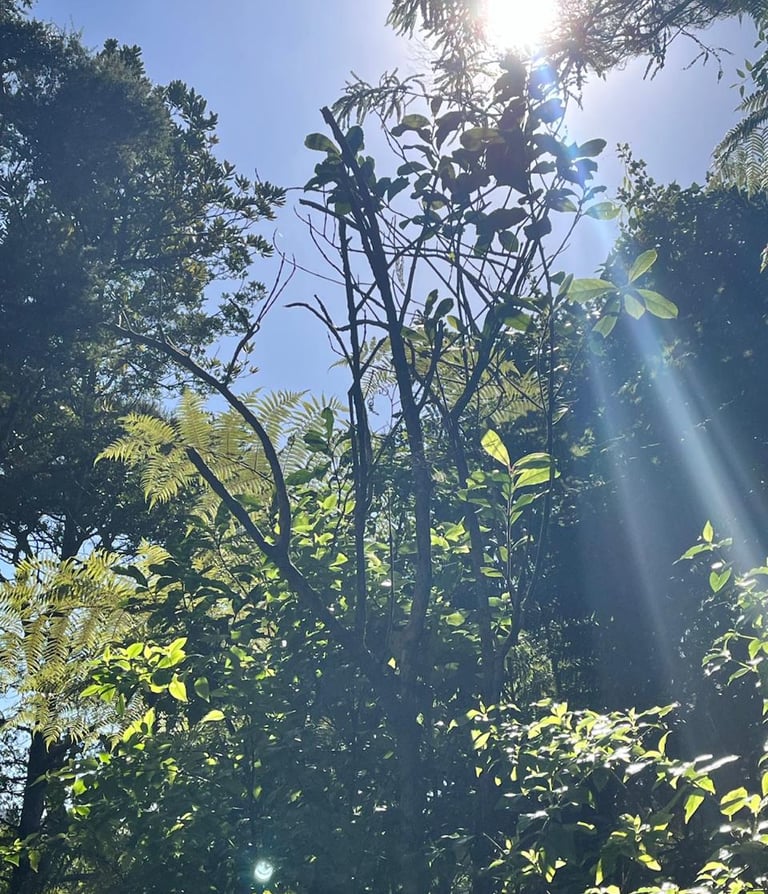
Soon in split of a second his mind started to race backwards. He thought about the forest, about the sunbeam penetrating the canopy. He thought about tonight, about an elderly woman struggling with a door and a teenager broken in a hospital bed. Different images, but the same message: “Love descends.”
It doesn't wait for you to climb up. It doesn't require you to be strong enough, good enough, worthy enough. It comes down to where you are, in the forest, at the Halal shop, at the door, in the hospital bed, in the 2 AM darkness of unemployment and purposelessness.
"But because of his great love for us, God, who is rich in mercy, made us alive with Christ even when we were dead in transgressions, it is by grace you have been saved" (Ephesians 2:4-5).
Even when we were dead. Not after we'd pulled ourselves together. Not once we'd proven ourselves. Even when we were dead.
"Jonathan?" He turned to find Aroha approaching, moving slowly with her walking stick.
"My daughter's going to stay the night. I'm heading home, she'll drive me." Aroha paused. "But I wanted to give you something before I left."
She reached into her bag and pulled out a small greenstone pendant-a hei tiki, traditional Māori. "This was my husband's. He wore it for forty years, thinking it would somehow make him strong enough to manage everything life threw at him. Like a talisman."
"I can't accept this," Jonathan protested.
"You can. You should." Aroha pressed it into his palm. "Because I want you to remember something different than what my husband believed. This stone didn't make him strong. It was just a reminder or should have been one, that strength isn't what makes us valuable. It's love. Being loved. Being held. Being treasured not for what we can do but for who we are."
Jonathan closed his fingers around the smooth stone, warm from her hand.
"God came down," Aroha said simply. "All the way down. To a manger, to a dusty province, to criminals and outcasts and regular broken people. He didn't wait for the world to rise up to meet Him. He descended. And He's still descending-into your unemployment, into your uncertainty, into your 2 AM drive to nowhere."
She patted his hand. "You didn't help me tonight because you were needed. You helped me because you saw me. That's what love does. It sees. It comes. It descends. And that's what God does too."
With that, she turned and made her way back to her family, leaving Jonathan standing in the hospital corridor with a greenstone pendant and a truth that felt simultaneously crushing and liberating:
He didn't have to earn this. Not the forest revelation. Not tonight's encounter. Not God's love. None of it had been wages for services rendered. All of it had been grace, descending like sunlight, like a stranger stopping to help, like a grandmother rushing to an injured grandson's bedside.
All of it had been gift.
Jonathan stood at the window for a long time, watching the darkness gradually yield to the first hints of dawn. The sun would rise soon not because the earth had earned it, not because humanity deserved another day, but because that's what the sun did. It descended again and again and again, faithful, and generous, asking nothing in return.
"Because of the Lord's great love we are not consumed, for his compassions never fail. They are new every morning; great is your faithfulness" (Lamentations 3:22-23).
New every morning. The same love, descending again, regardless of yesterday's failures or tomorrow's uncertainties. Just descending. Just coming. Just reaching down to touch the darkness and say, I'm here. I've always been here. And I'm not leaving.
As Jonathan finally left the hospital and drove home through the breaking dawn, he understood something he hadn't fully grasped in the forest: grace wasn't just a one-time revelation. It was a daily descent. A constant bending low. An eternal stooping down to meet us wherever we were- in the marketplace, in forests or hospitals, in clarity or confusion, in success or in the terrifying vulnerability of having nothing to offer but our own insufficiency.
And it was enough. God's descending love made it enough. Made him enough.
Not because Jonathan had finally gotten it right, but because Love itself had come all the way down.