When Heaven Bends Low (Part-I)
A single sunbeam piercing through dense forest canopy reveals a profound truth about divine love that changes everything for a weary humanitarian worker.
DAILY REFLECTIONS
Wandering Armenian
1/1/20268 min read

When Heaven Bends Low ( Part-I)
The trail had grown steep, and Jonathan's legs burned with each step. Behind him, Sarah navigated the roots and rocks with her characteristic grace, while Mervin and Jen, the young couple they'd befriended just months ago at church after moving to this new country, but who felt like lifelong companions, chatted easily about everything and nothing. In fact, there were times that Mervin would just give a short notice call to Jonathan to get read as he was going to take show some new nature spot, he had discovered in the city.
Jonathan had needed this. Months of forced stillness after years of constant movement had left him restless, questioning. The mission deployments to Haiti, Central Aisa, Myanmar -they had given his life structure, purpose, a clear sense of good and evil. But now, in the undefined space of unemployment, he felt unmoored. The silence at home, though filled with occasional family, echoed with a question he couldn't quite articulate: What now?
"Jonathan, look up," Sarah called softly.
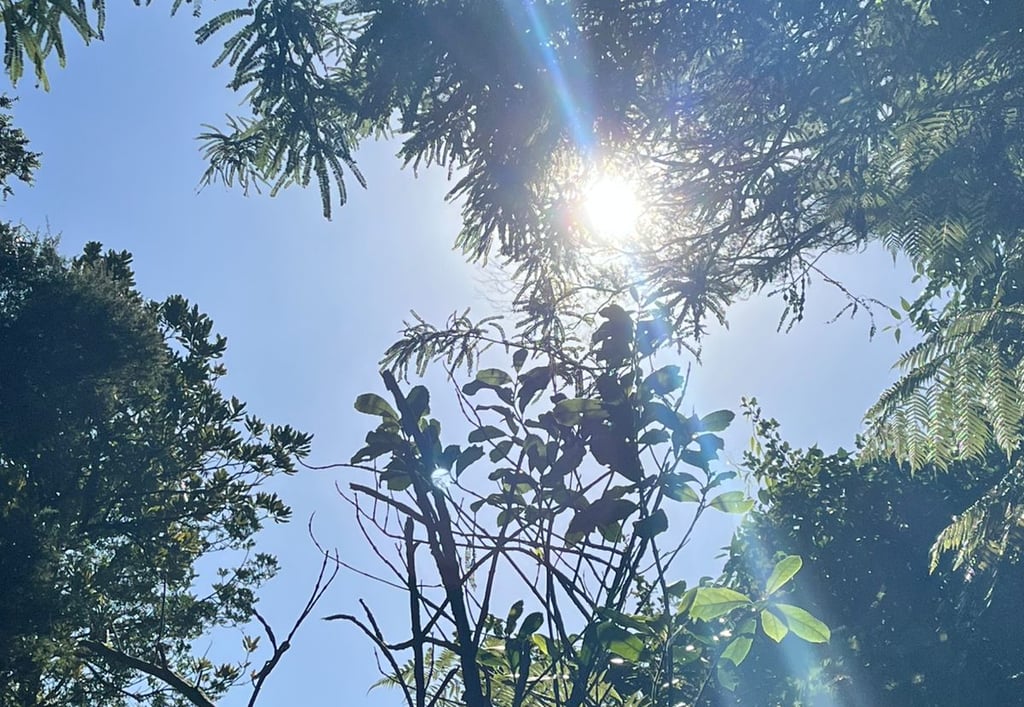
He stopped, lifting his gaze from the worn path. And there it was- a single, magnificent shaft of sunlight piercing through the dense canopy of tree ferns and native bush. The beam descended like a golden pillar, illuminating particles of mist and pollen that danced in its warmth. It touched a small cluster of emerging ferns on the forest floor, making them glow as if lit from within.
The sight arrested him completely.
For years, he'd witnessed suffering that defied description. He'd held the hands of the dying, distributed food to the starving, pulled children from rubble. He'd done it all with a sense of duty, of rightness, but lately, he'd been carrying a heavier burden, the weight of his own insufficiency. Every person he couldn't save. Every situation beyond his control. Every moment he'd been selfish when he should have been selfless. Every time he'd returned home irritable, distant, unable to leave the war and disaster zones behind.
I'm not enough, he'd been thinking. I've never been enough.
But this light...
"It's like heaven is reaching down just to touch the earth," Jen whispered, coming to stand beside him.
Jonathan nodded slowly, unable to speak. Because that's exactly what it was like. The sun, positioned somewhere high and unreachable beyond the thick forest canopy, was somehow making itself known in the darkness below. It wasn't waiting for the trees to part or for the forest floor to rise up to meet it. It was coming down, deliberately, specifically, to touch the smallest, most hidden things.
And suddenly, Jonathan understood.
"But God demonstrates his own love for us in this: While we were still sinners, Christ died for us" (Romans 5:8).
The verse came to him like a whisper, like the sunbeam itself. God hadn't waited for Jonathan to get it all right. Hadn't required him to climb up out of his insufficiency, his doubts, his darkness. Instead, Heaven had bent low. The Creator of all things had stooped down lower than Jonathan had ever descended into any disaster zone, to embrace humanity in its most broken state.
"You alright, mate?" Mervin asked, concern evident in his voice.
"Yeah," Jonathan managed, his throat tight. "Just... seeing something clearly for the first time in a while."
The sunbeam hadn't transformed the forest. The trees were still dense, the path still difficult, the shadows still deep. But that single point of light changed everything about how you experienced the darkness. You knew the sun was there. You knew it was reaching for you. You knew you weren't alone.
"The Lord is close to the broken hearted and saves those who are crushed in spirit" (Psalm 34:18).
Close. Not distant. Not waiting at some spiritual summit for us to complete the climb. Close.
Jonathan thought of all the times in field hospitals and refugee camps when he'd felt the presence of something greater than himself. He'd attributed it to adrenaline or purpose, but now he wondered if it had been simpler than that. Maybe it had been God, stooping into the devastation, saying I'm here. I'm here in this with you.
"Jonathan," Sarah touched his arm gently. She knew him well enough to recognize when something was shifting inside him. "What are you thinking?"
He turned to face her, then Mervin and Jen, these people who'd somehow become essential in his life. "I've spent years trying to be good enough. Trying to earn... something. Approval, purpose, redemption for all the ways I've failed. But that light..." He gestured to the sunbeam, which was already beginning to shift as the earth turned. "It doesn't ask the forest floor if it deserves to be touched. It just comes."
Mervin, who'd shared his own story of wrestling with faith after losing his brother, nodded slowly. "Grace isn't something we achieve. It's something that descends."
"Exactly," Jonathan breathed. "And it doesn't just descend halfway. It comes all the way down."
He thought of the incarnation, God becoming human, entering into suffering, limitation, death itself. Not because humanity had earned it. Not because we'd climbed high enough to merit attention. But because that's what love does. It stoops. It bends low. It penetrates the darkness not with demands but with presence.
"He has brought down rulers from their thrones but has lifted up the humble" (Luke 1:52).
There was a pattern here, Jonathan realized. God's way was always downward first-down to Egypt to free slaves, down to a manger in Bethlehem, down to a cross on Calvary before it was upward. The resurrection only happened after the descent. The exaltation only came after the humiliation.
"Maybe," Jonathan said aloud, still working through the thought, "maybe this time at home, this unemployment, this feeling of being stuck, maybe it's not punishment or failure. Maybe it's just... being in the forest. Being in the place where the light has to come find me because I can't generate it myself."
"And maybe," Sarah added softly, "learning to recognize it when it comes."
They stood together in silence, the four of them, as the sunbeam slowly tracked across the forest floor. Jonathan felt something loosening in his chest, some tension he'd been carrying for longer than just these years of unemployment. He'd been trying to be the light, he realized. Trying to be the rescuer, the strong one, the one who didn't need rescuing himself.
But the truth was simpler and more humbling: he was part of the forest too. Another creation that needed the Light to penetrate his darkness. Another soul that couldn't save itself, no matter how many others he'd helped save.
"For it is by grace you have been saved, through faith—and this is not from yourselves, it is the gift of God—not by works, so that no one can boast" (Ephesians 2:8-9).
A gift. Not a wage earned or a trophy won. A gift that descends like sunlight, seeking out the shadowed places not because they've earned illumination but because that's what light does. It gives itself freely.
"Should we keep going?" Jen asked gently.
Jonathan nodded, but he felt different now. Lighter. The path ahead was still uncertain, he didn't know when the next employment opportunity would come, or if it would come, or what form his life would take. But he knew something more fundamental now: the Light was already seeking him out. Grace was already descending. Love was already stooping low to meet him exactly where he was.
As they continued up the trail, Jonathan found himself thinking of everyone he'd encountered in his years of humanitarian work. The refugees who'd lost everything but somehow still offered him tea. The local volunteers who worked tirelessly with no international recognition. The children who drew pictures in the dust and shared them like treasures. The widows, both old and young who had taught him to bake various delicacies using amazingly simple flour, oil, salt, and sugar. They'd all taught him something he'd been too busy to fully understand; survival wasn't about being strong enough to climb out of the darkness alone. It was about recognizing the Light when it came, receiving it when it offered itself, and then, perhaps becoming a small opening through which that same Light could reach others.
"You are the light of the world," Jesus had said in Matthew 5:14. But he'd said it to broken fishermen and tax collectors, to ordinary people in an occupied land. Not because they'd achieved enlightenment, but because they'd received it. The light in them was borrowed light, reflected light, gift-light that had penetrated their darkness first.
That evening, as they sat around a small fire at the campsite, Jonathan finally put words to what he'd been experiencing. "I think I've been afraid," he admitted. "Afraid that if I stopped doing, I'd stop mattering. That if I wasn't actively helping, I'd just be... taking up space."
"But that's not how love works, is it?" Sarah said. "You don't love our kids because of what they do. You love them because they're yours."
"And God doesn't love you because you're useful," Mervin added. "He loves you because He's love. It's His nature, not your achievement."
Jonathan stared into the fire, watching the flames reach upward even as they consumed the wood below. Both movements at once ascending and descending, giving, and receiving. "The sunlight today," he said. "It reminded me that grace isn't passive. It doesn't just wait in heaven for us to figure out how to reach it. It actively pursues us. It penetrates our darkness. It finds us in the thick of things."
"Like God found you today," Jen said with a smile.
"Like God finds us every day," Jonathan corrected. "I just finally had eyes to see it."
"The Lord your God is with you, the Mighty Warrior who saves. He will take great delight in you; in his love he will no longer rebuke you but will rejoice over you with singing" (Zephaniah 3:17).
Rejoicing. Not reluctant tolerance of his failures. Not resenting acceptance of his limitations. But actual rejoicing, the way that sunbeam had seemed to celebrate the small ferns it touched, making them shine like they were the whole point of its journey through the canopy.
What if that was true? What if each person broken, insufficient, shadowed by their past and uncertain about their future was precisely the point? What if God's love weren’t waiting for us to become worthy but was actively delighting in who we were right now, while simultaneously drawing us toward who we'd become?
The fire crackled, sending up sparks that rose like inverse sunbeams, reaching back toward the stars. Jonathan felt at peace for the first time in months. He didn't have a job yet. His purpose wasn't clearer. His failures hadn't been erased. But he knew, really knew that he was pursued by a Love that stooped low, that penetrated darkness, that found him wherever he was and whispered, You are mine, and I am here.
And that, he realized, changed everything.
Because if grace descended to meet him in his insufficiency, then he could stop trying to climb his way to worthiness. If God's love stooped to embrace him in his brokenness, then he could stop hiding the cracks. If the Light actively sought the shadowed places, then even his unemployment, his doubt, his weariness could become sacred spaces where grace did its most profound work.
"Thank you," he said quietly to his companions, to the forest, to the Source of all light. "Thank you for coming all the way down."
And somewhere beyond the canopy, beyond the stars, the Sun of Righteousness smiled as He always had, as He always would—bending low to kiss the earth and everything on it with unearned, unending, unreasonable love.
"For great is your love, reaching to the heavens; your faithfulness reaches to the skies" (Psalm 57:10).
Reaching. Always reaching. Always descending. Always finding us in the forest, in the darkness, in the ordinary moments when we finally have eyes to see what has always been true: we are loved, not because we've climbed high enough, but because Love itself has bent low.