What the Basket Knew
A plastic basket. A simple misunderstanding. A profound truth: how we treat things- and people-tells the world what we think they're worth
DAILY REFLECTIONS
Wandering Armenian
4/6/20264 min read
What the Basket Knew
A Devotional
"Each of you should use whatever gift you have received to serve others,
as faithful stewards of God's grace in its various forms."
— 1 Peter 4:10 (NIV)
— ✦ —
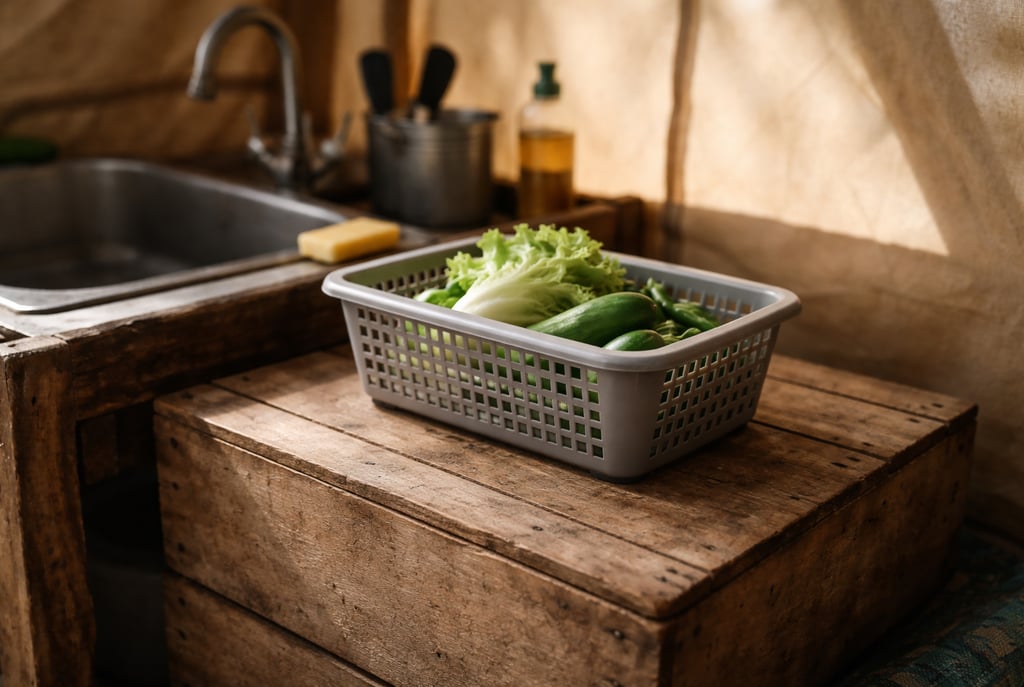
The basket was an unremarkable thin- small, grey, made of the kind of cheap plastic that lines the shelves of bazaar stalls in Cox's Bazar. Jonathan had bought it one afternoon for next to nothing, and it had found its home on the small wooden crate beside his makeshift sink inside the tent that served as both his office and his living quarters.
He used it for one purpose alone: washing vegetables. Each evening before cooking, he would carry it to the tap, rinse the day's okra or green chilies, and set them out to dry. It was a small ritual. A humble act of care in a place where nothing was permanent and everything was provisional.
Then one morning, Brahmanand appeared at the tent entrance -a quiet, gentle Bengali man from the coastal stretch of Noagaon, who had been a domestic worker for more years than he likely cared to count. He had kind eyes and calloused hands, and he moved through the small space with the practiced efficiency of someone long accustomed to making order out of other people's chaos.
He stopped when he saw the basket. "Dada," he said, tilting his head, "why are you keeping the garbage bin inside the kitchen?"
Jonathan looked at the basket, then at Brahmanand, and laughed softly. "That's my vegetable basket," he said. "For washing."
Brahmanand blinked, then nodded slowly, satisfied. But something in Jonathan was not quite finished with the moment.
The world often decides the value of things by the way we treat them.
That night, the monsoon arrived in its full fury. Rain hammered the canvas roof of his tent in great rolling waves, and Jonathan sat on the small plastic stool he kept in the entryway what he generously called his balcony and watched the camp turn to silver and mud beneath the downpour.
He was thinking about the basket. About how easily it had been misread. It sat beside his sink, humble and ordinary. It had no label, no sign. Its meaning was determined entirely by its context-by where it was placed, and how it was held.
And his mind moved, as it often did in that place, to the refugees. He had walked among them all week through lanes of tarpaulin and bamboo, past cooking fires and children's laughter and the quiet devastation of people who had lost everything. He had listened. He had sat with them in their hunger and their grief.
He had noticed, too, how the world treated them. How the way others looked at them seemed to shape the way even their neighbors and fellow displaced persons regarded each other with suspicion sometimes, or with dismissal, or with the particular cruelty of those who are themselves desperate and afraid.
We treat people the way we see others treat them, he thought. We let the world's assessment become our own. And we forget what the scripture has always insisted: that every person carries within them something given by God some grace, some gift, some irreducible dignity.
Jonathan had heard it first in Sunday school, in some church far from here, in a life that seemed to belong to someone else. He had heard it again in the voice of the elderly Rohingya grandmother who had pressed a small, crumpled piece of cloth into his hands last Tuesday- an embroidered panel she had somehow carried across the Naf River saying only, "Remember us."
He held that memory now the way you hold something fragile in both hands. Not because she was asking him to solve anything. But because she had trusted him to see her. Truly see her.
The rain eased to a murmur. Somewhere in the camp, a child was singing.
Jonathan picked up the basket from the crate, turned it over in his hands, and set it back down carefully. Not like garbage. Like something worth keeping.
— ✦ —
Reflection
There is a quiet theology in the way we handle ordinary things. The basket needed no label to declare its purpose, but it needed to be treated as what it truly was. So do the people around us.
In a world that assigns worth by visibility, productivity, and status, the gospel makes a different claim. Every person bears the image of God -the Imago Dei and every act of dignity we extend toward another is a form of proclamation. We are saying: this one has value. This one is seen.
How often do we absorb the world's verdict on people on the poor, the displaced, the forgotten and unconsciously repeat it in the way we speak to them, look past them, or fail to look at all? And how often might we reclaim the radical posture of Christ, who saw what others overlooked, and treated the unvalued as beloved?
A Closing Prayer
Lord, forgive us for the times we have let the world teach us how to see. Forgive us for the people we have reduced, dismissed, or made invisible not with malice, but with an unexamined gaze.
Give us eyes like Yours. Eyes that see past the surface to the grace buried inside every person we encounter. Teach us to handle people the way we would handle something precious because they are. Because You made them so.
And where we have forgotten this in our homes, our communities, our camps and our comfortable lives- call us back. Let how we treat the least among us become the truest measure of what we believe about You. Amen!!