These Beautiful Hands
A Maundy Thursday Meditation on the Priesthood of All Believers
DAILY REFLECTIONS
Wandering Armenian
4/1/20266 min read
These Beautiful Hands
Jonathan had not expected Maundy Thursday to find him like this, alone at a corner table in an old café, watching the last light of a Pacific afternoon pour through a wide window. After two decades in the field - dust-road camps, refugee crossings, disaster-rubble streets. He had learned to carry his faith the way a seasoned traveler carries a worn map: folded deep in his coat, consulted often, never surrendered. But today the café lady's words spoken to no one in particular yet landing squarely at his table had stilled everything inside him.
"Closing early today. It's Maundy Thursday. I have to go to Mass."
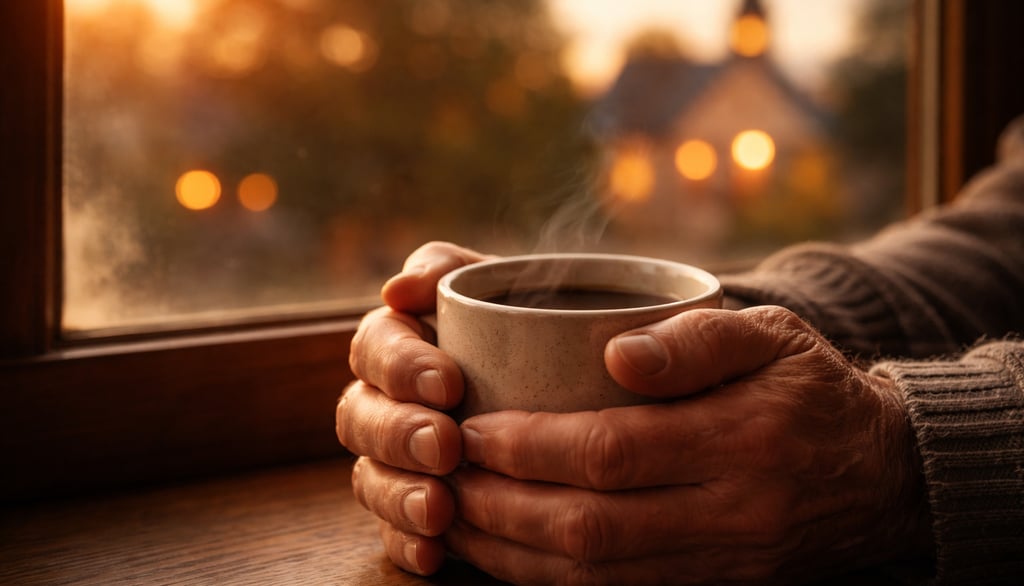
Something in the ordinary holiness of that sentence broke open a room inside him he hadn't visited in some time. He wrapped both hands around his cup, watched the steam curl, and let memory lead him gently backward, to a voice, a poem, a pair of hands raised in blessing over a broken world.
What you are about to read is not only Jonathan's story. It is the story of every ordinary person who has ever been shepherded through darkness by another ordinary person who somehow carried the sacred in their hands.
PART I — THE POEM HE COULD NOT FORGET
He couldn't remember who had first recited it to him. It might have been the old Jesuit chaplain in a Port-au-Prince field hospital after the earthquake, or the grey-haired nun who ran the feeding station outside Mosul, or the Anglican padre who appeared one evening at a little displacement camp at the edge of the small Greek village Polykastro, with nothing but a thermos of tea and an unshakeable peace about him. Whoever it was, the poem had taken root.
He had wept the first time he heard it. Not from sentimentality, as Jonathan was not a sentimental man, but because the poem pressed on something real and aching: the knowledge that in his hardest moments, it had always been someone's hands that had reached him. And many of those hands had belonged to men of God.
PART II — A LIFE SHAPED LIKE A CALLING
Father Emmanuel had been ordained at twenty-six in a small diocese in West Africa. He had not chosen the priesthood the way one chooses a career. It had chosen him-the way a river chooses its bed, with patient, irresistible pressure- through years of watching suffering that no one in power bothered to name, through late nights reading by candlelight, through a retreat where he had knelt on a stone floor until his knees ached and heard, in that ache, something very like a summons.
He had studied in Rome. He had served in a bush parish so remote that Mass vestments arrived by donkey. He had baptised infants as well as grownups in river water when nothing else was available, and administered last rites in languages he did not speak, trusting that God was a better translator than he would ever be.
When Jonathan first met him, Father Emmanuel was sixty-one and had the hands of a man who had used them — heavily, constantly, reverently. Broad palms, thick knuckles, fingers that had broken bread ten thousand times and still handled it as though it might, at any moment, become something holy.
"My hands are not my own," he had told Jonathan once, with no drama in his voice. "They were lent to me for a purpose. I am trying to return them in better condition than I received them."
But you are a chosen people, a royal priesthood, a holy nation, God's special possession, that you may declare the praises of him who called you out of darkness into his wonderful light. [1 Peter 2:9]
Jonathan had thought about that verse for years. He thought about it now, in the café, as the afternoon dimmed and the café lady locked the door behind her and walked in the direction of the church.
PART III — THE HANDS IN THE FIELD
In the humanitarian world, Jonathan had met a great many priests. But he had also met people who were not priests by ordination, yet who functioned unmistakably as priests by vocation.
There was the Kenyan nurse who held dying strangers' hands as though they were her own kin, murmuring prayers in Swahili with the same unselfconscious fluency with which she charted vitals. There was the young Swiss logistician who, despite being a confessed agnostic, would sit with newly displaced families in the evening and listen-really listen and with such quality of attention that people afterwards looked calmer, less alone, as though they had been, in some unnamed way, absolved.
There was the Ethiopian water engineer who blessed each new well before it was commissioned, not as an official ritual but because he believed, as he said, "that clean water is a prayer that works." All of them had beautiful hands.
Jonathan had written in his journal once: "I am beginning to think the priesthood is wider than any one tradition knows. I am beginning to think God hands out vestments that are invisible to the eye but felt at the soul."
PART IV — WHAT MAUNDY THURSDAY INSISTS ON
Maundy Thursday is the night of the towel and the basin.
It is the night when the Son of God-who, as John's Gospel takes pains to note, knew exactly who he was and where he was going -knelt on the floor and washed his disciples' feet. Not as a performance of humility. As an instruction.
Now that I, your Lord and Teacher, have washed your feet, you also should wash one another's feet. I have set you an example that you should do as I have done for you. — John 13:14–15
Sitting in the café, Jonathan felt the weight of that exchange settle over him like a vestment.
This, he thought, was the priesthood that Peter was speaking of. Not an office. A posture. A willingness to kneel. A willingness to touch what is dirty and treat it as holy. To hold what is broken and call it beloved. To show up in life's early morning and at its close -with open hands.
He thought of his own hands. Twenty plus years of fieldwork. Forms filled, crises managed, systems navigated. And yet, the moments that had mattered, the ones he would carry to his own grave-were not the systems. They were the hands.
The hand he had held in a cholera ward in Haiti. The child's wrist he had steadied during a medical evacuation in the Cox’s Bazar. The shoulder of a colleague he had gripped in a parking lot in Nangarhar (Afghanistan) when the man was about to break under the weight of the work.
"We are all, in the end, either priests or deserts," Father Emmanuel had said once. And Jonathan had not understood it then. But he understood it now.
PART V — THE CALLING THAT BELONGS TO ALL OF US
He ordered a second coffee -the café lady had left the machine on and trusted him to lock up and he sat with the stillness of the emptied room.
He was not ordained. He did not wear a collar. He had never presided at an altar. But he had, he realized, lived something shaped very much like a priestly life: moving toward suffering rather than away from it, trying to hold space for the human and the sacred to meet, attempting to leave each place a little more whole than he found it.
And so had the nurse. And the logistician. And the water engineer. And the café lady, who had said "Maundy Thursday" with such quiet conviction that it had cracked him open at the seams.
The royal priesthood, Peter writes, belongs to all believers. It is not an elevation. It is an invitation into a particular kind of lowness, the lowness of the basin and the towel, of the hands raised not in triumph but in blessing, of the life poured out not in a single dramatic gesture but in ten thousand ordinary ones.
In early morning. At its close.
In the clasp of friendship. In the midst of woes.
Again, and again, and again.
Therefore, I urge you, brothers and sisters, in view of God's mercy, to offer your bodies as a living sacrifice, holy and pleasing to God — this is your true and proper worship. [Romans 12:1]
Jonathan looked at his own hands wrapped around the coffee cup. Not beautiful, exactly. Scarred a little. Weathered. Marked by the work. But perhaps that was exactly right.
We need them in life's early morning,
we need them again at its close.
we feel their warm clasp of friendship,
we seek them tasting life's woes.
At the altar each day we behold them.
When we are tempted and wander
to pathways of shame and sin,
it's the hand of a priest that will absolve us —
not once, but again and again.
And when we are taking life's partner,
other hands may prepare us a feast,
but the hand that will bless and unite us
is the beautiful hand of a priest.
God bless them and keep them all holy,
for the host whose fingers caress;
when the hour of death comes upon us
may our courage and strength be increased,
by seeing raised over us in anointing
the beautiful hands of a priest.