The Bread That Folded into Prayer
A twist of dough. A refugee camp in Greece. A Pacific cafe window. One quiet Lenten morning, Jonathan’s hands remember what his heart is still learning. A Wayfarer’s Meditation on Pretzels, Lent, and the Posture of Waiting on God.
SOJOURNER
Wandering Armenian
3/31/20266 min read
The Bread That Folded into Prayer
“So, I say to you: Ask and it will be given to you; seek and you will find; knock and the door will be opened to you.” - Luke 11:9 (NIV)
The Tray in the Window
The morning had the unhurried quality of a day that expects nothing from you. Jonathan sat at a corner table in the kind of Pacific suburb cafe that smells of roasted beans and quiet ambition -the sort of place where laptops outnumber conversations and no one questions a man who simply stares.
He had been doing a great deal of staring lately.
The months since the last deployment had passed like sediment settling at the bottom of a jar slowly, invisibly, until you noticed how clouded everything had become. The world’s humanitarian map had been redrawn by new anxieties and shrinking budgets. Priorities had shifted. Programs had folded. And Jonathan, whose adult life had been plotted across conflict zones and border crossings, had found himself doing something utterly foreign: staying still, and occasionally baking.
He and Sara had made the crossing too -a different continent now, a different set of morning sounds, a neighborhood where the biggest crisis was whether the recycling bins were set out on the right day. He was grateful. He was also quietly, persistently lost.
It was then that the café worker set a fresh tray on the counter.
Pretzels. Golden, lightly salted, their twisted forms still releasing a breath of steam into the cool air. Jonathan looked at them, and something in his chest shifted the way a locked door shifts when the right key is finally turned.
Lesbos, 2016
The wind off the Aegean had been unrelenting that September. Jonathan remembered it as a physical thing, not weather so much as argument, pressing back against every small act of order the relief workers tried to impose on the chaos of the shore.
The camp at Moria was already straining beyond its designed capacity when his team arrived. Families from Syria, Afghanistan, Iraq, Yemen and Libya -the Beg family among them, Akbar clutching a ruined suitcase and Sultana walking with her youngest on her back, the child so exhausted it had stopped crying and simply endured. Jonathan had seen that endurance before. It was the posture of people who had run out of choices but had not yet run out of faith.
A local Greek Orthodox volunteer named Eleni had brought bread one evening - not loaves, but a basket of small, twisted rolls. A nun from a nearby monastery had baked them, she explained, because it was a fast day and the monastery had little else to offer. But the shape, Eleni said, pressing one gently into Sultana’s hands- the shape was the point.
“They call it a pretiola,” she said. “A little reward. Monks baked them in the shape of arms crossed in prayer. Children who had memorized their prayers were given one as a gift.”
Jonathan had turned the small roll in his hands that evening, standing at the edge of the camp while fires were lit against the Aegean dark. Arms crossed at the chest. A body at prayer. The most ancient gesture of surrender he knew.
He had eaten it slowly. He had prayed slowly too.
A Little Reward for Faithful Arms
The history of the pretzel, it turns out, is the history of Lent told in dough.
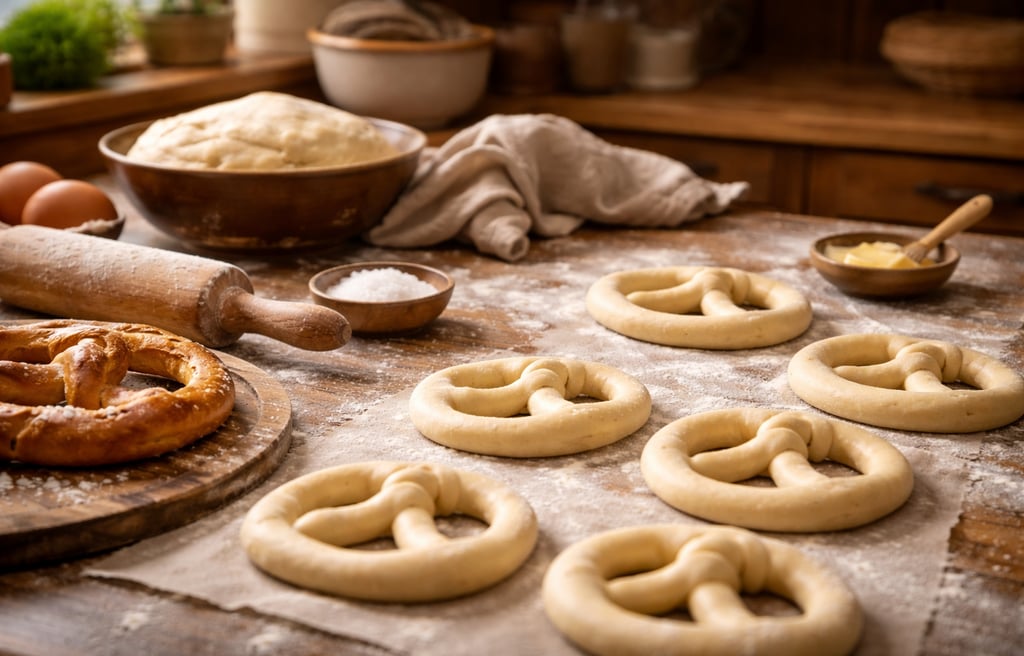
Scholars trace the shape to early Christian monasteries - likely in the monasteries of southern France or northern Italy, sometime in the sixth or seventh century. Monks baking during the Lenten season, when eggs, lard, and dairy were forbidden, discovered that a simple paste of flour, water, and salt could be twisted into the shape of arms folded in prayer across the chest was the posture the faithful assumed when praying in those centuries. The word itself travels through Italian -pretiola, little reward and the German Brezel, before arriving in its modern English form.
In the old Lenten tradition, the pretzel was not merely bread. It was a mnemonic -a physical reminder, placed in the hands of children and adults alike, of the discipline of the season. To hold a pretzel was to hold a prayer. To eat it was to ingest, however symbolically, the posture of surrender before Yahweh.
Three holes in the twist: Father, Son, and Holy Spirit.
Two interlocking loops: the crossing of arms, the bowing of the self.
Salt: the mineral memory of tears, of covenant, of the preserved and the set-apart.
Jonathan had not known most of this on that Aegean evening. But his hands had known something. Sometimes the body understands what the mind is still working out.
The Last Week
It was the final week of Lent now. Jonathan knew this because as he passed by his neighbor’s house on his morning walks, he’d see Mrs. Denzel lite a candle each morning outside their home at the grotto-a quiet liturgical habit she had kept since childhood, one she carried across from her father’s home the way other women carry good jewelry. Six candles had burned. The seventh was waiting.
Outside, the world was not observing any particular season of stillness. Gaza burned. Sudan bled. Iran was bleeding too. The Myanmar junta pressed its quiet catastrophe further into the hills. Somewhere in Eastern Europe, another city was measuring its streets in blast radius. The humanitarian machinery Jonathan had given his best years to was groaning under the weight of a world that had found more crises than it had funds or will to address.
He thought about Akbar and Sultana Beg. He did not know where they were. He had learned, long ago, not to follow those threads too closely -not because he did not care, but because the caring had to be bounded or it would consume everything. He had prayed for them at intervals over the years, releasing their names upward like small lights sent into the dark, trusting that Yahweh kept what Jonathan could not track.
That too, he realized now, was a kind of pretzel posture. Arms folded. Hands empty. Surrendered.
Ask. Seek. Knock.
Luke 11 is often read as a passage about persistence in prayer and it is that. But Jonathan had come to hear in it something else, something that the pretzel shape made suddenly visible: it is also a passage about posture.
To ask is to open the mouth, yes -but first, it is to acknowledge that you do not have. It is the posture of the empty-handed, the out-of-work, the between-continents. To ask requires the crossing of arms that says: I have reached the end of what I can do alone.
To seek is the posture of the pilgrim -the wayfarer, Jonathan thought, almost smiling, the one who does not sit down in the wilderness and wait for the map to come to him, but who moves, however tentatively, in the direction of the thing he has not yet found. It is not frantic seeking. Lenten seeking is slow. It is the shuffle of a man in a Pacific suburb cafe watching steam rise off a tray of twisted bread, letting memory and mercy move in the same direction.
To knock is to stand at a door you did not build and cannot force. It is the most vulnerable of the three verbs. It requires that you believe someone is home. That they hear. That the door, in its own time, opens.
Jonathan looked at the pretzel in his hand now -he had bought one without quite deciding to -and he felt the accumulated weight of the season settle around him not as burden but as something closer to companionship. The Lenten dark was almost over. Holy Week was at the threshold. The cross and the empty tomb waited at the end of the road, as they always did, as they always would.
But for now, this Wednesday morning, it was enough to sit in the quiet, hold bread shaped like a prayer, and ask.
For Your Road Today
In this final stretch of Lent or in whatever waiting season you find yourself, consider the three verbs of Luke 11:9 not only as commands but as postures:
Ask: What are you holding that you need to release into open hands?
Seek: Where is Yahweh inviting you to move, even in small increments, toward renewal?
Knock: What door are you afraid to stand before and what would it mean to simply raise your hand?
The pretzel, in its humble twisted form, has carried the posture of prayer across fifteen centuries of fasting seasons, refugee camps, monastery kitchens, and suburb cafés. Perhaps it still knows something worth learning.
A Lenten Prayer of the Wayfarer
Yahweh, I come to You in the posture of the open-handed. I do not know what the next chapter holds-only that You are the Author of it. For every Sultana who carries her child across a sea, for every Akbar who clutches what is left of what was, for every Jonathan sitting in a quiet café waiting for the map to make sense: let our arms fold in surrender, not defeat. Let our stillness be the kind that listens. And let us eat whatever bread You place in our hands as though it were, in some small holy way, a gift. Amen.